
M
E
N
U
Cyberworx Technologies Pvt Ltd
C-9/15, Sector-7, Rohini, New Delhi
Delhi110085, INDIA
IN:+91-8377009038



If you've noticed your organic traffic sitting flatter than it used to, even
while your rankings look fine, you're not imagining it. Google now answers a huge share of
queries directly on the results page, and the click many businesses used to count on simply
doesn't happen anymore. That shift is why "AEO" has gone from a niche acronym to something
clients are actually asking about.
This isn't really a story about SEO being replaced. It's a story about where the value in a
search result now sits, and whether your brand shows up in that value, click or no click.
SEO is the practice of shaping a site and its content so search engines can find it, understand it, and rank it above competitors for relevant queries. That hasn't stopped mattering. It's just no longer the whole picture. The core levers are still keyword research, technical health (speed, indexing, mobile performance), backlinks, on-page structure, and content quality. Sites that neglect these basics don't show up anywhere, AI-generated answer or not.
On-page SEO is entirely different from off-page SEO. Some optimizations are visible on the page, while others are hidden. To understand the difference between these optimizations, let us know the basics of on-page and off-page SEO.
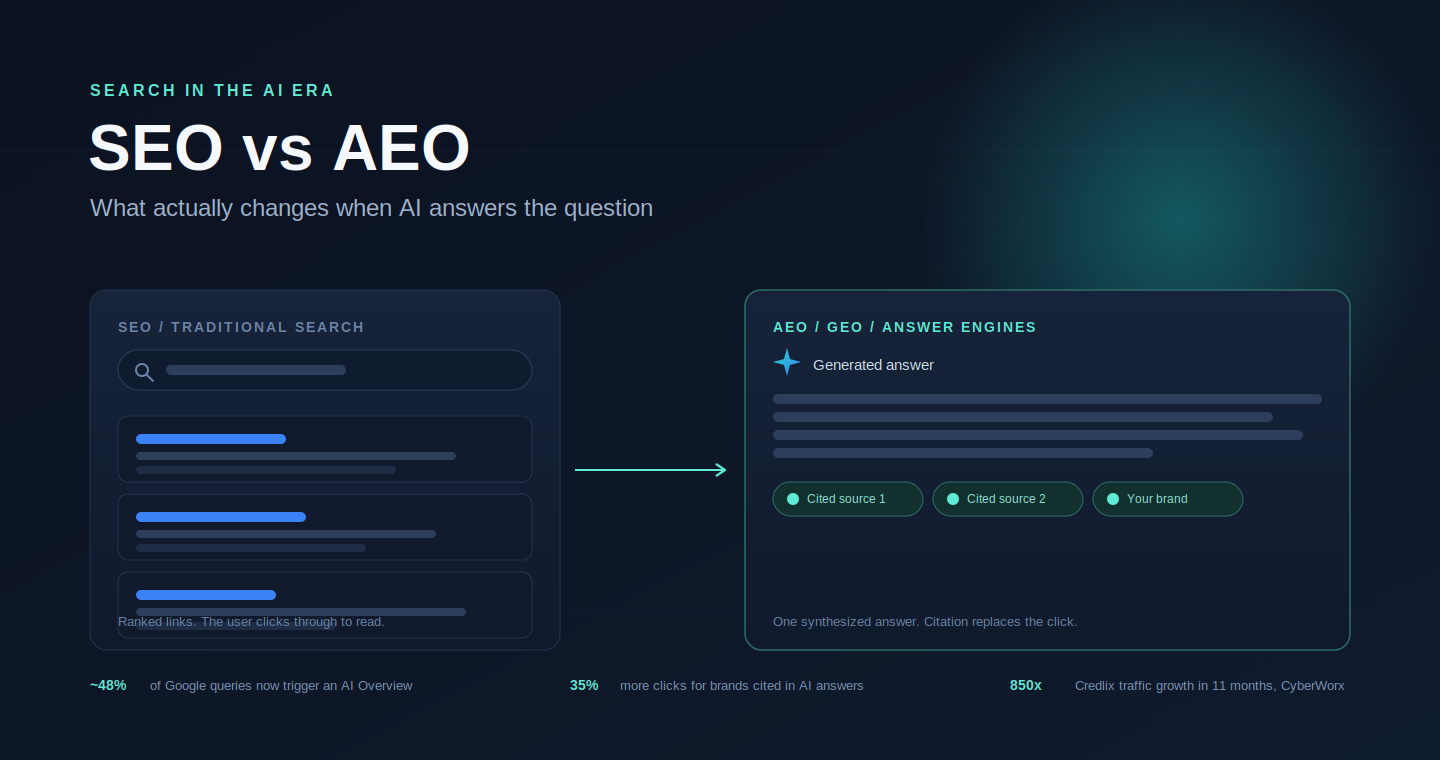
Answer Engine Optimization is the practice of structuring content so AI systems (Google's AI Overviews, ChatGPT, Perplexity, Gemini, voice assistants) can lift it directly into a generated answer, ideally with your brand named as the source. Where SEO optimizes for a ranking position, AEO optimizes for being the sentence an AI decides to quote or paraphrase.
The reason this has become urgent rather than theoretical is scale. Multiple 2026 trackers converge on a similar number: AI Overviews now appear on somewhere around 45–48% of tracked Google queries, up roughly 58% year-over-year (BrightEdge Generative Parser, Feb 2025–Feb 2026). Coverage varies a lot by market and topic: one dataset puts Indonesia at over 37% of keywords and the US around 20% (SeoProfy/Brand Radar analysis), while another finds healthcare and education queries triggering AI Overviews 78–83% of the time (BrightEdge, 2026). The spread between studies is wide because methodologies differ, but the direction is not in question: this is a fast-growing, not a fringe, phenomenon.
The traffic consequence is the part that should get a marketing team's attention. Estimates of the US zero-click rate (searches that end without any click to a website) range from roughly 58% to around 60–68% depending on the source and methodology, and SparkToro/Datos clickstream analysis put the share of searches sending a click to the open web at just 36%. When an AI Overview specifically appears on a query, click-through on the top organic result has been measured dropping anywhere from around 58% to as high as 61% across different studies (Ahrefs, Seer Interactive). Not every number agrees, but every study agrees on the direction.
None of this means visibility stops mattering. It means visibility is being redefined. Seer Interactive's research found brands cited inside AI Overviews earn roughly 35% more organic clicks and 91% more paid clicks than uncited brands competing on the same query (Seer Interactive, Nov 2025), and a separate 2026 update from the same firm found cited brands pulling in about 120% more organic clicks per impression than uncited competitors. Getting named inside the answer, in other words, is now doing some of the work a top-three ranking used to do.
Bain & Company's February 2025 consumer research found 80% of US consumers now rely on AI-generated results for at least 40% of their searches, with organic web traffic down an estimated 15–25% across many sectors as a direct result. That's a business problem, not just a search-engine curiosity: it's traffic that used to land on a website and now doesn't.
|
|
SEO |
AEO |
|
Optimizes for |
Ranking position on a results page |
Being quoted or cited inside a generated answer |
|
Typical content |
Long-form pages, guides, landing pages |
Concise, well-structured, directly-answerable sections |
|
Key levers |
Keywords, backlinks, technical SEO, UX |
Schema markup, clear semantic structure, citable statistics and sourcing |
|
Where it shows up |
Google, Bing organic listings |
AI Overviews, ChatGPT, Perplexity, Gemini, voice assistants |
|
Success looks like |
A click to your site |
A citation, mention, or brand recall, click optional |
They aren't competing disciplines. A page still needs to rank reasonably well, or be crawlable and trusted enough, before an AI system is likely to pull from it at all, since most of the tools generating these answers are still built on top of a traditional index.
Generative Engine Optimization is the academic and now-commercial term for optimizing content specifically for AI systems that synthesize answers from multiple sources rather than linking to one. The term traces back to a 2024 Princeton and Georgia Tech study, later published at the ACM SIGKDD conference, which built a benchmark called GEO-bench across roughly 10,000 queries spanning nine datasets and found that specific content techniques (adding citations, statistics, quotations, and clearer sourcing) could boost a page's visibility in generative engine responses by up to 40%. That 40% is a ceiling from the strongest tactics tested, not an average outcome, but it's a real, peer-reviewed data point rather than an agency talking point, which is more than most claims in this space can say.
In practice, most people now use AEO and GEO almost interchangeably to mean "getting cited by AI systems." The distinction that still matters: AEO tends to describe the answer-box-and-voice-assistant discipline that grew out of featured snippets, while GEO describes the newer, broader practice of engineering content for LLM-style synthesis. For a business deciding what to actually do, the practical guidance overlaps heavily.
Aggregate stats are useful for the "why," but three named, documented cases show what the "how" actually looks like.
HubSpot, one of the most visible brands in the CRM category, published a first-party account of its own AEO program in 2026. Starting in June 2025, HubSpot's marketing team began measuring how often it appeared in ChatGPT, Gemini, and Perplexity answers using a third-party tracking tool, then built a three-part strategy: rewriting on-site content to be citation-friendly, expanding its presence on third-party publishers, and monitoring Reddit, since Reddit turned out to be one of the most-cited sources in its tracked prompts. The specific tactics and results, per HubSpot's own published account:
Worth saying plainly: this is a fast-moving area, and public data on it is inconsistent. Different trackers report AI Overview prevalence anywhere from 20% to 60% of queries depending on methodology, market, and date. Treat any single "X% of searches now..." statistic, including the ones above, as directionally right rather than exact. What isn't in dispute is the trend: AI-generated answers are capturing a growing share of search attention, click-through on traditional results is falling, and being cited inside the answer is becoming a measurable, trackable form of visibility in its own right. Businesses that only optimize for the ten blue links are optimizing for a shrinking share of the outcome.
Sources: BrightEdge Generative Parser (2025–2026), SparkToro/Datos clickstream data, Seer Interactive AI Overview studies (2025–2026), Bain & Company "Goodbye Clicks, Hello AI" (Feb 2025), Pew Research Center, Aggarwal et al., "GEO: Generative Engine Optimization," ACM SIGKDD 2024 / arXiv:2311.09735, HubSpot "How HubSpot became the #1 CRM in AI search" (2026), Vajra Global AEO experiment case study (2026), CyberWorx client data for Credlix (2026).